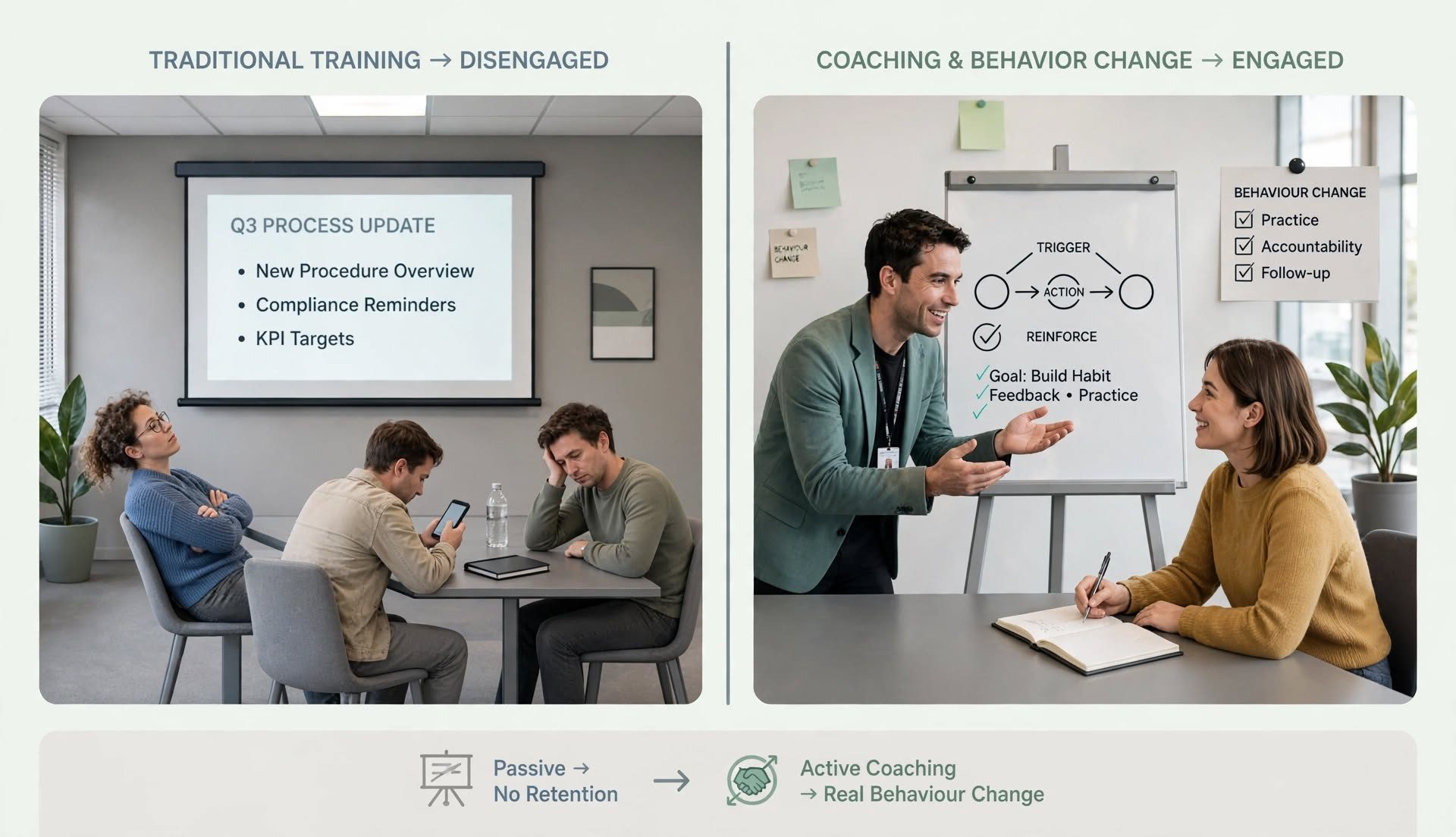
Most training doesn’t fail in the room. It fails the following Monday. Participants leave energised, rate the session highly, and then return to a workplace that looks exactly as it did before. If your programs score well on satisfaction but nothing shifts on the job, the problem is rarely the content. It’s the design around it.
Knowledge isn’t the same as behaviour
Many programs are built to transfer information: frameworks, models, best practices. But people rarely fail at work because they lack information. They fail because the new behaviour is harder, slower or riskier than the old habit, and nothing in their environment makes the change easier.
Behaviour change needs three things at once: the capability to act differently, the opportunity to do so, and the motivation to try. Most training addresses only the first.
The forgetting curve is working against you
Without reinforcement, learners forget most of what they hear within days. A single workshop, however good, can’t compete with thousands of hours of established routine. Spaced practice, short refreshers and real application tasks do far more to build lasting habits than a longer event ever will.
The manager is the missing link
The strongest predictor of whether learning transfers is what happens when the learner returns to their team. If a manager doesn’t know what was taught, doesn’t expect it to be used and doesn’t recognise it when it is, the new skill quietly dies.
Brief managers before the program. Give them two or three specific behaviours to look for and a simple way to coach them. Better still, build their involvement into the program itself.
How to fix it
- Start with the behaviour, not the topic. Define what people should do differently, in observable terms, before you design anything. “Improve communication” is a topic. “Give feedback within 48 hours using a set structure” is a behaviour.
- Diagnose the barriers. Ask whether people lack skills, tools, time, permission or incentive. Training only solves one of these.
- Design for practice. Replace presentation time with rehearsal, simulation and feedback on real work.
- Extend the learning beyond the event. Plan 30, 60 and 90-day touchpoints: nudges, peer discussion, manager check-ins and on-the-job assignments.
- Measure what matters. Go past completion rates and smile sheets. Track the behaviour itself and the business metric it should move, such as error rates, customer scores or time to productivity.
A different question
The question to ask isn’t “Was the training good?” It’s “What is different in the business because of it?” When you design backwards from the behaviour you want, involve managers and keep learning alive after the session ends, training stops being an event and starts delivering the change you promised.
How to fix it
- Start with the behaviour, not the topic. Define what people should do differently, in observable terms, before you design anything. “Improve communication” is a topic. “Give feedback within 48 hours using a set structure” is a behaviour.
- Diagnose the barriers. Ask whether people lack skills, tools, time, permission or incentive. Training only solves one of these.
- Design for practice. Replace presentation time with rehearsal, simulation and feedback on real work.
- Extend the learning beyond the event. Plan 30, 60 and 90-day touchpoints: nudges, peer discussion, manager check-ins and on-the-job assignments.
- Measure what matters. Go past completion rates and smile sheets. Track the behaviour itself and the business metric it should move, such as error rates, customer scores or time to productivity.
A different question
If your training scored 9/10 for engagement, but nothing changed on Monday morning — did it actually work?
Our Sponsors:
The Australian Learning & Development Network’s events and resources are available free of charge to our members due to the generous support of our sponsors. As such, if you’re looking for any externally provided capability development services, we kindly ask that you contact them to discuss your needs.
- Frontline Management Training Australia – Purpose-Built Leadership and Management Training for Frontline Managers and Staff
- Australian Public Sector Training – Leadership and Management Training Specifically for People Working in Public Sector Organisations
- Executive Development Australia – Inspiring Executive Excellence



You must be logged in to post a comment.