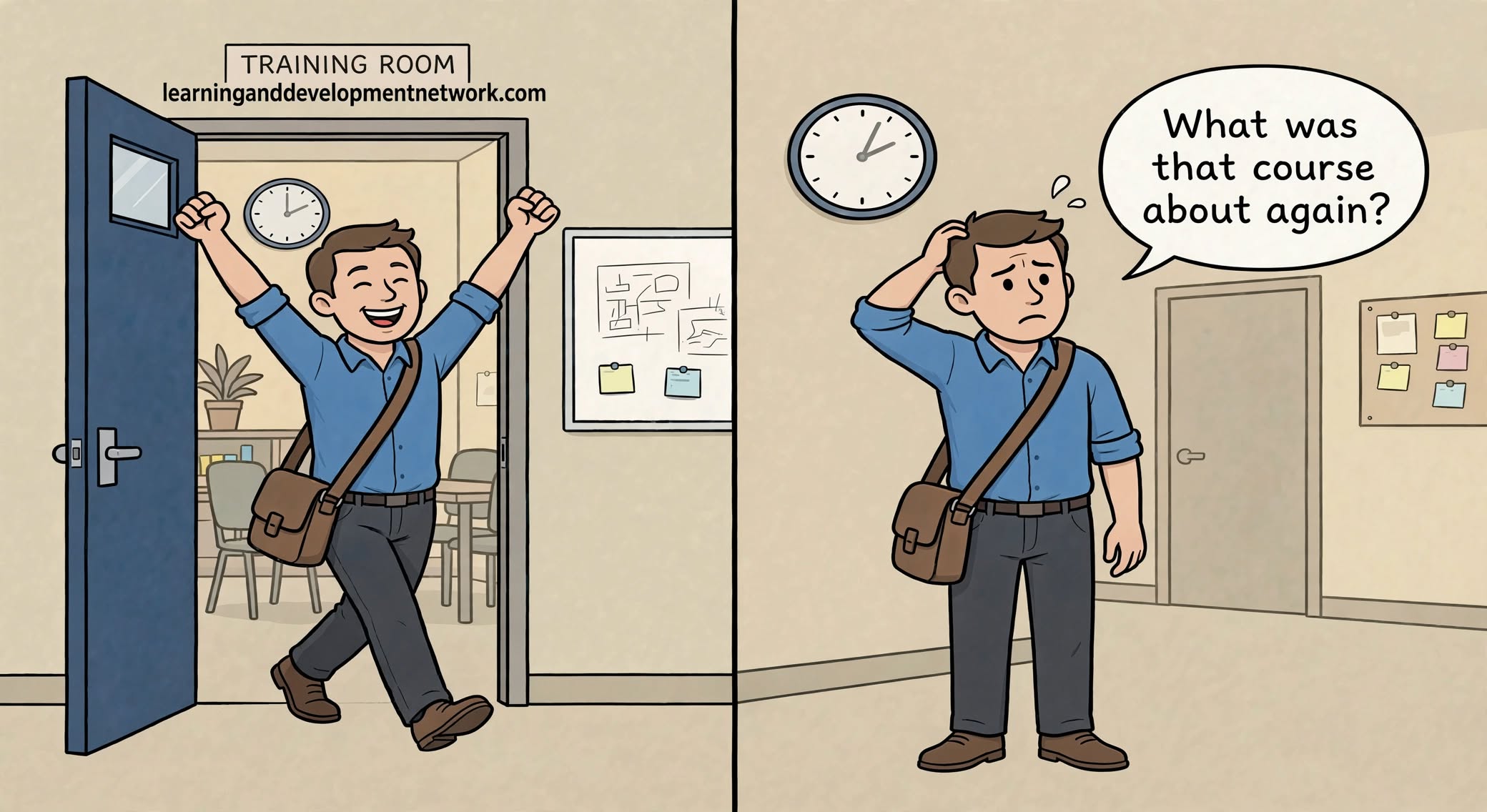
This week’s Learning & Development Network ‘Friday Funny’ is titled ‘Inspired at 2pm, forgotten at 2:05pm’.
You know this person.
At 1:59pm he’s buzzing. He just finished your workshop. New framework, great discussion, a notebook full of ideas. He walks out of the Training Room with his arms in the air.
At 2:05pm he’s standing in the hallway thinking: “What was that course about again?”
We laugh because we’ve all been him. And if you’re an L&D Manager, you’ve also watched hundreds of him walk out your door.
That comic isn’t about motivation. It’s about memory. And it’s costing us more than we like to admit.
The 2:05pm Problem is Real
Inspiration feels like learning, but it’s not. Ebbinghaus showed us over a century ago what happens next:
- ∼50% of new information is lost within an hour if there is no attempt to retrieve it
- ∼70% is lost within 24 hours
- Up to 90% is lost within a week
Your learner isn’t lazy or disengaged. His brain is doing exactly what brains do — clearing short-term cache unless you give it a reason not to.
Most of our training is still designed for the 2pm moment. We optimize for the reaction sheet. Did they enjoy it? Was it engaging? 4.8/5. But we under-design for the 2:05pm moment, which is the only one that changes performance.
Why Inspiration Evaporates
1. We teach for the event, not for the job.
The workshop is a contained world. The real world has interruptions, old habits, and a manager asking for that report. If the learning doesn’t have a clear landing pad in the workflow, it won’t land.
2. We rely on recall when we should design for retrieval.
Listening and note-taking feels like learning, but retrieval is what builds memory. If a learner doesn’t have to struggle to recall it, apply it, and get feedback on it within the first 24-48 hours, it fades.
3. We finish at the end of the course.
The course ends, so our support ends. Exactly when the forgetting curve is steepest.
What L&D Managers Can Do Before 2:05pm Hits
You don’t need more content. You need a transfer architecture.
Before the Training Room:
- Start with a manager conversation, not a calendar invite. One question: “What will you be doing differently next week if this works?” It creates a reason to remember.
- Prime with a 2-minute problem. Send a real scenario the day before. Let them get it wrong. Curiosity is a better adhesive than objectives.
Inside the Training Room:
- Cut one topic to add three retrievals. End each module with: “Without looking at your notes, write the 2 steps you would use on Monday.” Then peer-check it.
- Make them leave with one thing, not ten. One behavior, one conversation, one tool they will use in the next 24 hours.
After the Training Room — Where Learning Actually Lives:
This is where 80% of your impact is decided.
1. The 24-Hour Nudge: A 3-question scenario via Teams / Slack the next morning. Not a quiz on content, a quiz on application.
2. The Manager Multiplier: Give managers a 5-minute huddle guide, not a summary deck. “Ask your team: Where did you try this week? What got in the way?”[X]
3. Job Aids Over Memory: If they have to remember it, they will forget it. Put the framework where the work happens — a one-pager, a checklist in the CRM, a prompt in the template.
4. Spaced Practice, Not Spaced Content: Don’t send video 2 of 5. Send the same core concept in a new context 3 days later, 7 days later, 21 days later.
What reinforcement, nudges, or practice opportunities do you build in the first 48 hours after training?
Our Sponsors:
The Australian Learning & Development Network’s events and resources are available free of charge to our members due to the generous support of our sponsors. As such, if you’re looking for any externally provided capability development services, we kindly ask that you contact them to discuss your needs.
- Executive Development Australia – Inspiring Executive Excellence
- Frontline Management Training Australia – Purpose-Built Leadership and Management Training for Frontline Managers and Staff
- Australian Public Sector Training – Leadership and Management Training Specifically for People Working in Public Sector Organisations



You must be logged in to post a comment.